
Key Findings
- Silent Push Preemptive Cyber Defense Analysts uncovered North Korean remote workers running a fake construction and engineering company using the domain thegreathouse[.]us, posing as “The Great House.”
- On our first call, the operator we engaged had no camera on. During the second, the operator turned on his camera and used real-time deepfake software that showed layering artifacts and facial distortion before he cut the video feed.
- A registrant email links the site to DPRK operations; the domain was registered with devtop0109[@]gmail[.]com, an address on a publicly reported list of 1,400 emails attributed to North Korean IT workers. The email registered thegreathouse[.]us and no other domain.
- Multiple state phone numbers and the listed address contradict the company’s website contact details. The domain registration adds yet another phone number and address.
- The same playbook has moved into a new industry. The tradecraft matches the fake companies Contagious Interview has used to target developers. This time, though, no malware is delivered, and the operator, now running a fake construction company, goes after building contracts directly instead of trying to lure job applicants.
Table of contents
Executive Summary
Silent Push Preemptive Cyber Defense Analysts recently identified thegreathouse[.]us, a fake construction and engineering company operated by North Koreans. The site presents itself as “The Great House,” a residential and commercial contractor based in Lynchburg, Virginia. The operation is built to win large construction and engineering projects and generate revenue for the North Korean regime.
Posing as a prospective client, our research and analysis team held two video calls with the site operator, who used the name “Edward.” During the second call, we identified multiple indicators consistent with deepfake software, including visible layering artifacts and facial distortion (“folding”). The operator consistently kept his mouth out of frame and declined our request to hold a hand in front of his face, a common technique for detecting real-time facial manipulation.
In this blog, we share our recordings of both calls with the operator.
Background
We have been tracking North Korean threat actors for many years. Our research has produced several public blogs and exclusive customer reports on the Contagious Interview APT group, a Lazarus subgroup also tracked as Famous Chollima and WageMole.
In April 2025, we published Contagious Interview – April ’25 Update, which mapped three fake cryptocurrency consulting firms operating as fronts for the group: BlockNovas LLC, Angeloper Agency, and SoftGlide LLC. Each front ran a full corporate facade, including a registered business address, AI-generated employee photos, fake LinkedIn profiles, and GitHub repositories used to deliver BeaverTail, InvisibleFerret, and OtterCookie malware to job applicants. That research was covered by Reuters.
In June 2025, we published our analysis of five years of computer logs recovered from machines the actors had infected with their own InvisibleFerret malware. Those logs pushed the campaign’s start back to 2020, three years before its first public identification. They also exposed the service stack the group relies on to build false identities: Astrill VPN and dedicated Russian IP ranges, temporary SMS providers, AI face-swap and headshot generators, resume builders, and a vendor selling counterfeit passports and driver’s licenses.
Taking a Different Approach
In this blog, derived from our ongoing research, we cover how this group of North Koreans is taking a different approach. By investing in complete, durable false identities rather than one-off lures or malware deployment, the group stays under the radar and operates in a sector (construction) where North Korean remote workers are not typically noticed.
The Great House applies the same tradecraft to a different market. Instead of luring developers into fake interviews for potential IT worker jobs, the operator behind thegreathouse[.]us pursues construction and engineering contracts directly, then carries the persona through live video using deepfake software. The fake company, the Western persona, and the synthetic face all serve the same purpose: to generate revenue for the North Korean regime.
Our research covers a single front company and the two calls we held with its operator. We started with a publicly reported list of email addresses attributed to North Korean IT workers and expanded the picture through Full WHOIS registrant pivots, webscan history, and open-source collection on the company’s LinkedIn presence.
We can confidently assess that thegreathouse[.]us is operated by a North Korean remote worker. The assessment rests on the registrant email appearing in a publicly reported list of DPRK IT worker addresses compiled by third-party researchers, combined with the deepfake tradecraft observed directly on the video calls.
In addition to the Silent Push platform for proactive protection, our Traffic Origin IP geolocation and reputation solution provides important information about the physical origin of web traffic and actual locations.
As Our Research Began
We found overlap between our email findings and other high-fidelity North Korean email lists reported publicly.
In this case, a threat researcher named “SttyK” posted a 1400-email address list that, according to them, is being used by North Korean IT Workers.
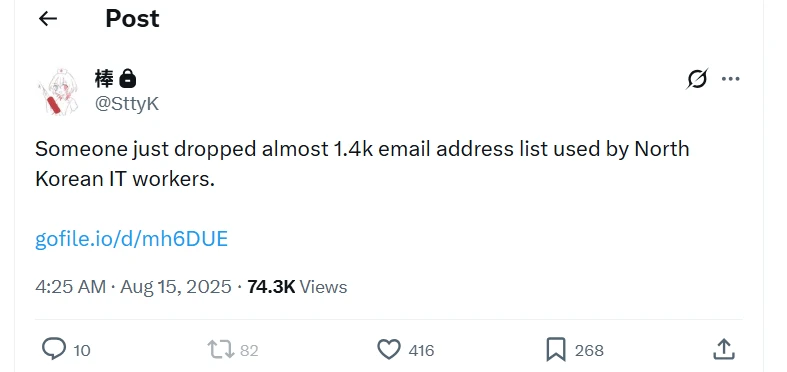
The gofile[.]io link is no longer active. Fortunately for us, another threat researcher who goes by the name Rakeshkrishs12 published the full list as an attachment: Unmasking DPRK IT Workers: Email Address Patterns as Hiring Red Flags
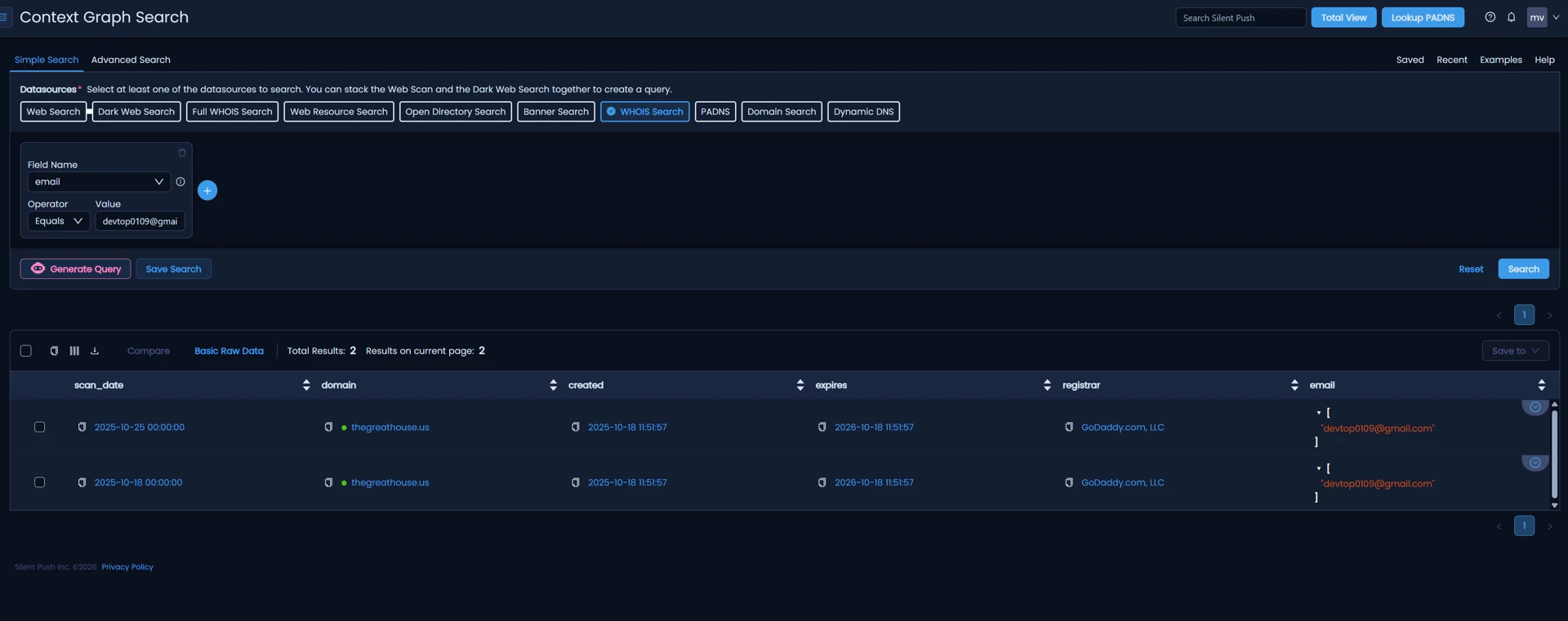
We use threat-hunting workflows to detect malicious campaigns that use any of the emails we are searching. In this case, we found an interesting domain created with the email address devtop0109[@]gmail[.]com. The pivot returned thegreathouse[.]us and no other domain.
Using the query: datasource = "whois" AND email = "devtop0109@gmail[.]com" in Silent Push Community Edition yielded the results shown below.
Website – The Great House
The domain thegreathouse[.]us was created on October 18, 2025. As of this writing, it is still actively serving the content (shown below).
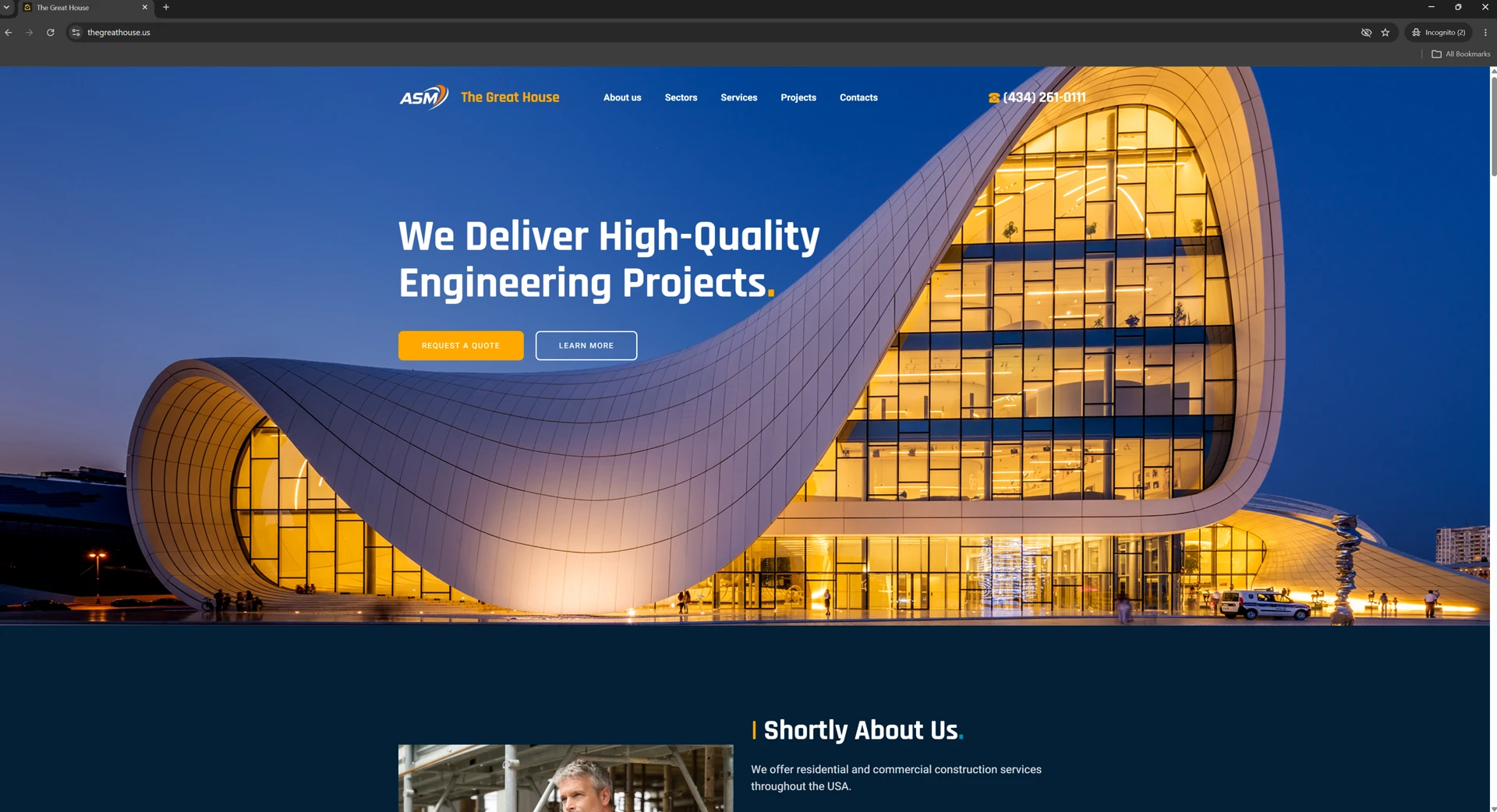
The website thegreathouse[.]us mentions the following content:
| Company | The Great House, a construction and engineering company in Lynchburg, VA, offering residential and commercial construction across the USA |
| Services | Design & Build, Project Management, Construction, Remodeling, Renovation, Preconstruction, and Interior Design |
| Sectors | Commercial, Residential, Interiors, plus Industrial and Healthcare |
| Claims | 10+ years in business, 200+ clients, 60k+ sqft built |
| Team | Architecture, structural engineering, MEP |
| linkedin[.]com/company/the-great-house | |
| Telegram | t[.]me/thegreathouse19 |
| james[@]thegreathouse[.]us | |
| Phone (displayed) | (434) 261-0111 |
| Phone (tel: link) | +1 479-410-0717 |
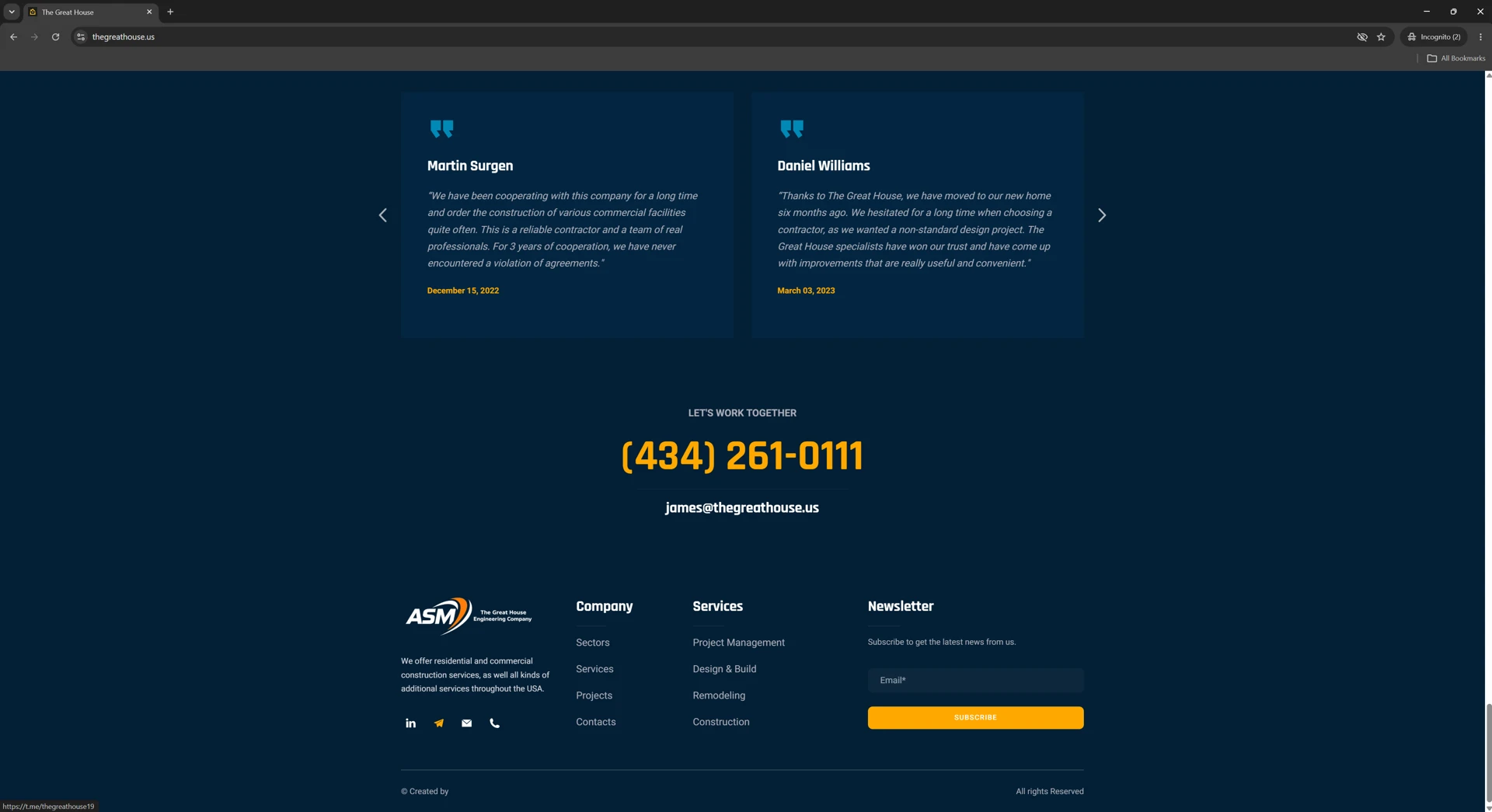
Various details on TheGreatHouse[.]us, particularly the contact page, did not match up. The site displays “(434) 261-0111,” matching the claimed Lynchburg, Virginia location’s area code, while the telephone link in the page markup pointed to “+14794100717,” which refers to an Arkansas area code. The domain registration lists a third telephone number, “+1 351-345-0257,” with a Massachusetts area code, along with a New York registrant address rather than one in Virginia.
First Meeting: Edward from The Great House Construction
We reached out to the Telegram account thegreathouse19 found on thegreathouse[.]us, and set up a conversation with the individual “Edward,” behind the account. Getting Edward to turn his camera on took some persistence. In the first meeting, which lasted about 25 minutes, his camera was off the entire time. We condensed the recording to 8 minutes and 47 seconds and share it below.
Fake Project Proposal Exposes North Korean IT Worker Scam
Initially, Edward seemed genuinely interested in the project. When we told him we’d need identity verification to proceed, he resisted. As a compromise, he agreed to turn on his camera for the second meeting.
Edward from The Great House Construction Company Using Deepfake Software
For the second meeting, we finally got the individual we assessed as North Korean to turn on his camera. Almost immediately, we detected signs that he was using deepfake software to superimpose a different face over his actual appearance.
We also noticed he seemed to keep his mouth out of frame on purpose. This was likely because the deepfake software couldn’t keep his lip movements synced with his voice, causing a visible lag. It became more apparent when we asked him to lean back in his seat, which gave us a clearer view of his full face and made the inconsistencies easier to spot.
To test our suspicion further, we asked him to hold a hand up in front of his face. He declined, instead feigning confusion about the request. At that point, it was evident he understood we’d caught on to the deepfake. He ended the video feed shortly thereafter. You can view the full video below.
Exposing a North Korean IT/Remote Worker Using Deepfake Software
Steps to Reduce Risk and Continuing to Track North Korean Remote Worker Schemes
For deeper insights into the North Korean recruiting scheme we recently detected on a Discord server, see our “Proactively Defending Financial Institutions Against North Korean Remote Workers” research. It shares how a remote North Korean recruiter offered U.S., E.U., and Latin American citizens 35% of a salary to act as the face and the legal identity on job applications. The remaining 65% goes back to the North Korean worker through cryptocurrency, wire transfers, or third-party payment processors. The report explains why the scheme passes document-based KYC (Know Your Customer) and AML (Anti-Money Laundering) checks, shows how connection-origin data exposes it, and sets out indicators that HR, fraud, and cybersecurity teams can use to spot a North Korean IT worker before onboarding.
Our team will continue to track North Korean fake construction and IT worker front companies, along with the deepfake and false identity tradecraft that keeps them running. We’ll report new findings as our research progresses.
Until then, organizations that hire contractors, vendors, or remote staff can reduce their risk with these steps:
- Test video calls for deepfakes. Ask the person to hold a hand in front of their face, turn their head to the side, or lean back from the camera. Watch for blurred edges, facial distortion, and lips that don’t match the audio. Treat a refusal as a red flag.
- Check that contact details line up. Compare the phone numbers, area codes, and addresses on the website with the domain registration and the company’s claimed location. Legitimate local businesses rarely list numbers from three different states.
- Compare a company’s claims with its history. The Great House claims more than 10 years in business, but its domain was registered in October 2025. A new domain behind a long track record deserves a closer look.
- Verify licenses and credentials independently. Construction contractors have to be licensed in most states. Look up the license yourself through the state licensing board, not through a link that the prospective company sends you to check.
- Be cautious with Telegram-only contact and pushback on verification. Real contractors expect identity checks and will usually agree to meet in person or visit the site. Pressure to skip those steps should slow the deal down.
- Report suspected North Korean IT worker activity. In the U.S., report it to the FBI through the Internet Crime Complaint Center (IC3).
If you or your organization has information to share on this topic or related topics, we always welcome the opportunity to collaborate.
Interested in Learning More?
Start a conversation with one of our platform experts to learn how our preemptive cyber defense can give your security team more lead time on adversary infrastructure, before an attack is launched.
Our free Community Edition lets defenders try the technology and see how our platform integrates with their existing security stack.