Threat actors have a process, and most security tools are designed to respond to it after the fact. Preemptive cyber defense changes that by identifying adversary infrastructure during the preparation phase, before anything malicious lands.
Before a phishing campaign reaches an inbox, before a command-and-control (C2) server receives its first callback, there is a period of preparation. Infrastructure gets registered and aged. Servers come online, DNS records resolve, and certificates rotate. The attacker’s process is methodical, and because it is methodical, it leaves a trail.
Most security tools are watching the wrong part of that timeline. By the time an Indicator of Compromise (IOC) surfaces in your stack, the attacker has already completed the preparation phase. The infrastructure has been live and operational for weeks. Your tools are doing their job, just after the window to act has already closed.
We built the Silent Push Context Graph for that window.
The Context Graph continuously maps the internet’s DNA, tracking how infrastructure is created, changed, and managed across DNS, WHOIS, certificates, and hosting data every single day. Critically, it analyzes everything, not just known-bad infrastructure. Future threats do not emerge from known-bad sources alone. They grow from what looks ordinary today. Think clean domains on legitimate hosting providers, servers that have not yet received a single malicious instruction, certificates that look identical to thousands of others…
Threat actors deliberately stage their operations inside normal-looking infrastructure because they know most tools are only watching the parts of the internet that have already been flagged. The Context Graph watches everything, because that is the only way to see what is coming.
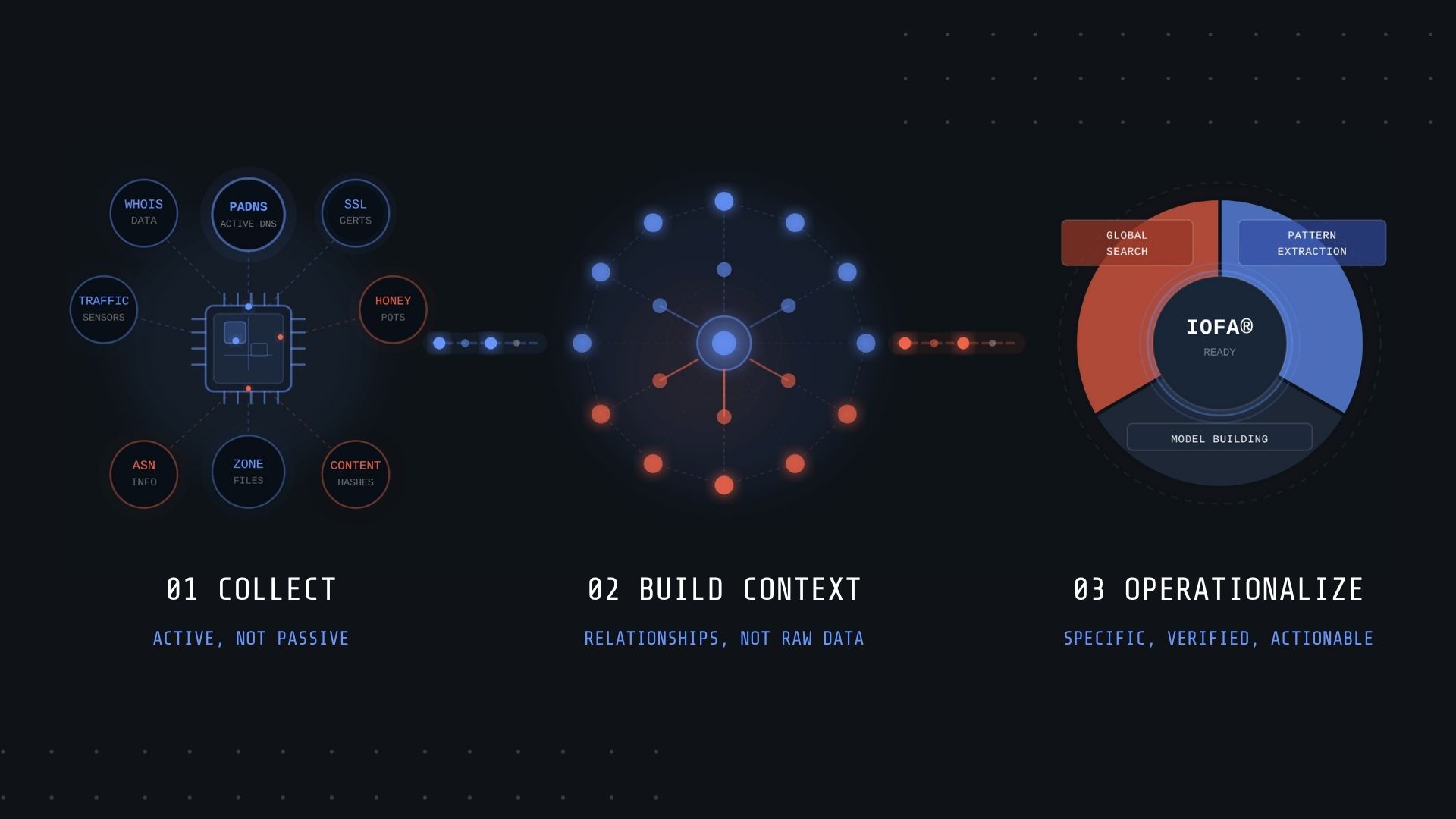
When management patterns emerge that match the way adversaries build and operate campaigns, the Context Graph turns them into Indicators of Future Attack® (IOFA): verified signals of a staging ground that exists right now, before it has been used against anyone.
Unlike risk scores based on domain age or registration history, IOFAs are grounded in how infrastructure is actively being built and managed, following the same operational tactics, techniques, and procedures (TTPs) that adversaries use every single time. Even when they rotate hosting providers or change subnets, the process stays consistent. The Context Graph knows those processes, which is how it surfaces what is coming before it arrives.
For security teams, this changes the fundamental shape of defense. Instead of catching up to the last campaign, you have lead time on the next one. Instead of remediating what has already happened, you block the staging ground before the campaign ever leaves it.
A Source of Truth Your Security Workflows Can Trust
Security teams are increasingly running automated workflows and AI-assisted triage inside their SIEM and SOAR platforms. The quality of those workflows depends entirely on the quality of the data feeding them. Noisy probability scores and unverified threat feeds produce unreliable automation: false positives that burn analyst time, automated responses that act on the wrong signals, and AI agents that draw flawed conclusions from data without clear provenance.
Our platform was built to be machine-consumable from the ground up. Every signal carries clear data provenance. The APIs are designed explicitly for automated triage. When your security workflows reason from deterministic signals rather than probability guesses, they stop generating noise and start taking actions you can trust. For teams building agentic security workflows, the Context Graph provides the kind of reliable, pre-correlated intelligence that makes safe automation possible.
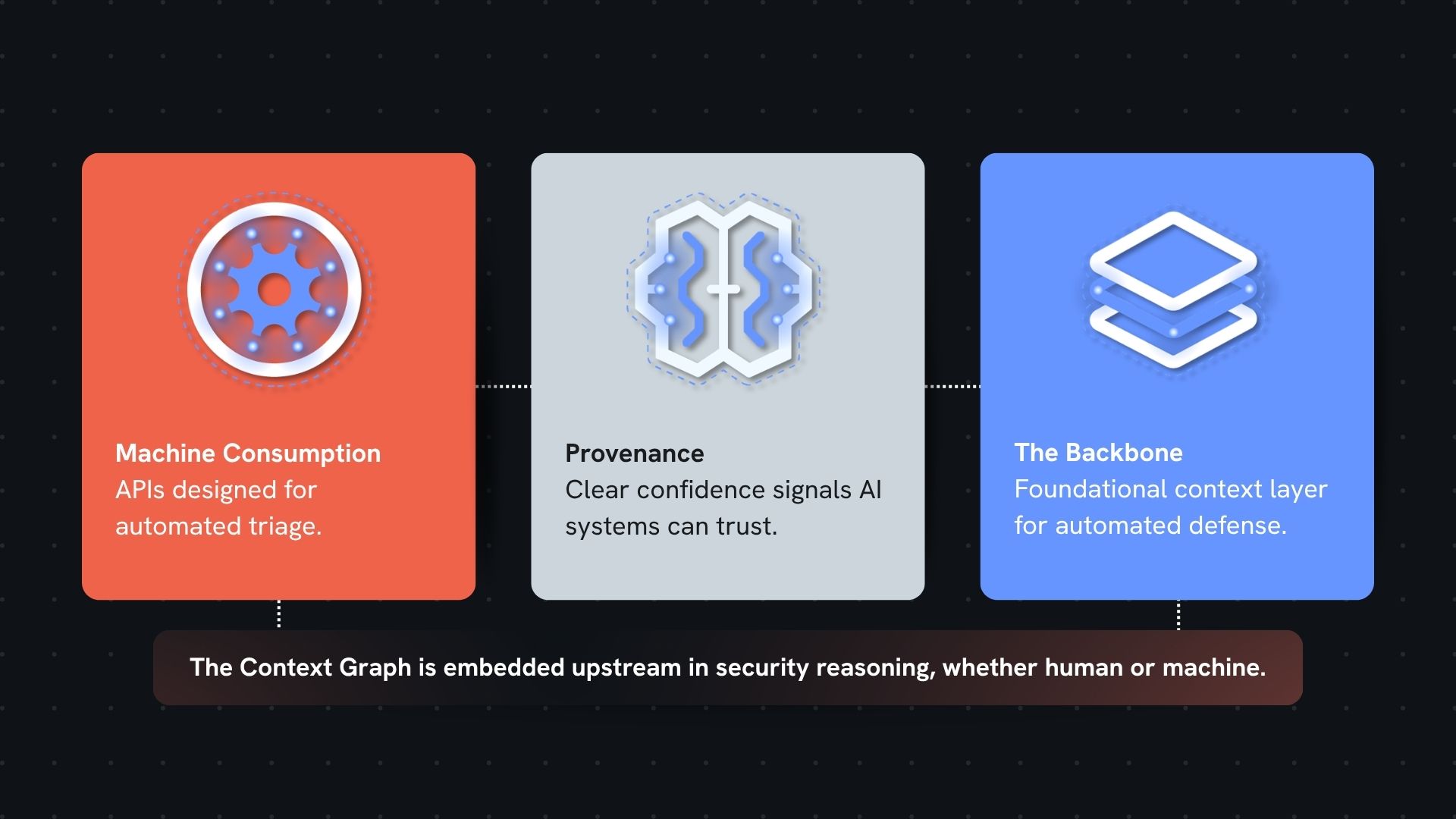
Here is what that looks like in practice for SOC and IR teams.
- SOC teams: automated triage and noise suppression. Automated workflows can consume the Context Graph directly into SIEM or SOAR platforms to automatically validate, enrich, and act on alerts. The Threat Check API provides an instant, deterministic true or false answer on any indicator, eliminating manual cross-referencing entirely. Instead of analysts spending hours pivoting between tools to verify a single alert, the enrichment happens automatically and only verified threats reach the queue. Mean time to detect and mean time to triage both drop significantly.
- IR teams: instant scoping and complete eradication. During an active incident, automated systems leveraging the Context Graph can take a single IOC and immediately pivot to map the adversary’s entire infrastructure footprint. Connected DNS history, certificate chains, and IP clusters surface in seconds rather than hours. IR teams can generate comprehensive blocklists that cover the full scope of the adversary’s operation, not just the entry point they found first, which is what prevents the same attacker from returning through infrastructure you missed.
- Blocking pre-weaponized threats automatically. Because the Context Graph operates upstream in the attack lifecycle, automated workflows can operationalize IOFAs to neutralize staging infrastructure before an attack ever launches. Instead of automating the response to threats that have already reached your perimeter, you automate the prevention of threats that have not arrived yet.
The distinction matters. If your security automation is focused solely on clearing alert queues faster, you are still playing the attacker’s game, just at greater speed. Embedding the Context Graph into your workflows moves your automation to a point in the timeline where the adversary still has options you can take away.
How the Context Graph Fits Into Your Security Stack
The Context Graph is not a replacement for the tools your team already uses. Historical threat intelligence, internet scanning, noise filtering: these are real capabilities and they belong in a mature security stack. What none of them cover is the preparation phase, the window between when an adversary starts building their infrastructure and when it goes active.
Preemptive cyber defense does not replace legacy security. It fills the gap that legacy security was never designed to cover.
The Context Graph integrates directly into existing SIEM, SOAR, and TIP workflows via a fully API-first architecture, feeding verified indicators into the platforms your team already works in. Your analysts spend less time pivoting between systems and more time acting on intelligence that has already been correlated and verified.
Get Started
Interested in seeing the Context Graph in action? Talk to one of our platform experts about how Silent Push can help your team neutralize threats before they reach your perimeter.
We also offer a free Community Edition, giving security practitioners and researchers introductory access to the Silent Push platform and datasets.