Why a global financial company replaced three data sources with one
Industry: Financial Services
Role: Security Engineer
Use case: Data consolidation, API ingestion, infrastructure data quality
A Security Engineer at a global fintech was building an internal graph solution to map risk dynamically across their infrastructure. To do that, they needed external data they could pull directly into their own environment via API and combine with internal signals.
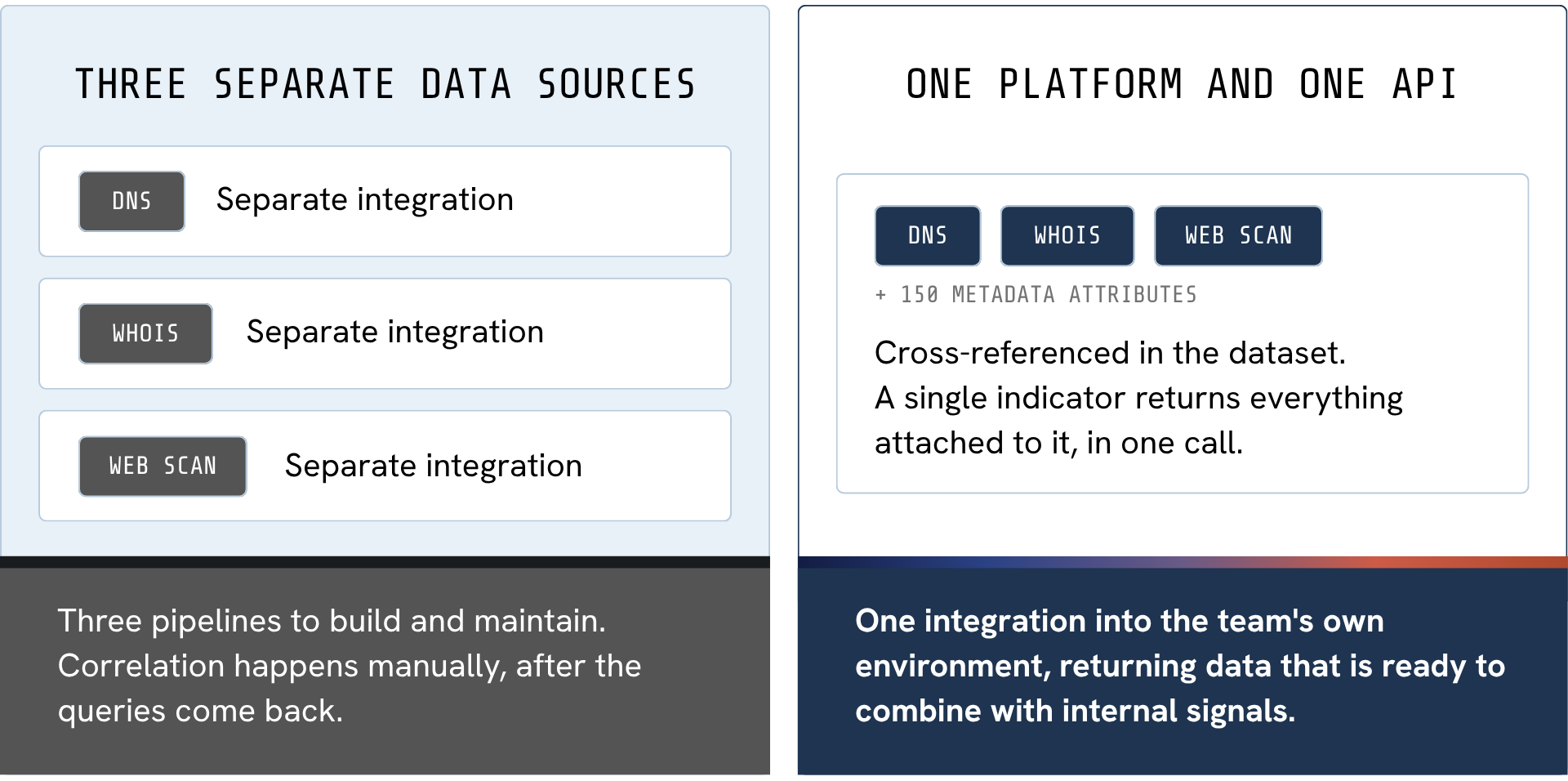
Getting a complete picture of any given indicator meant querying three separate sources: one for DNS, one for WHOIS, and one for web scan data. Each had its own format, its own access method, and its own gaps. Correlating across all three manually was slow. Building automated pipelines across three different APIs added complexity that got in the way of the actual analysis.
One Pipeline for Multiple Datasets
Silent Push brings DNS, WHOIS, and web scan data together in a single platform, accessible through one API. For the analyst’s team, that meant replacing three separate integrations with one, and working with data that is already cross-referenced rather than needing to be reconciled after the fact.
The quality of the DNS data matters here as much as the consolidation. Silent Push manages its entire DNS collection pipeline and resolves it actively. Traditional passive DNS only captures resolutions that have already happened through user traffic. Silent Push aggregates domains and IPs from zone files and certificate transparency logs, then forces active resolution across the full dataset daily. The data reflects infrastructure as it is being built, not just infrastructure that has already been accessed.
WHOIS and web scan data follow the same principle. Registration changes, hosting patterns, SSL certificates, favicon hashes, HTML content, and 150+ other metadata attributes are all indexed continuously and queryable through the same API. When a new domain appears in the dataset, its WHOIS record, scan fingerprint, and DNS history are already attached.
What changes when the data is in one place
The practical difference is in how much an analyst can do with a single query. When DNS, WHOIS, and scan data sit in separate systems, moving between them requires separate queries, separate authentication, and manual correlation. When they sit together, a single indicator returns everything attached to it across all three datasets in one call.
For a team building a risk graph on top of external data, that is the difference between a usable data source and one that creates as much work as it saves.
To see how Silent Push data works via API, book a walkthrough with our platform experts.