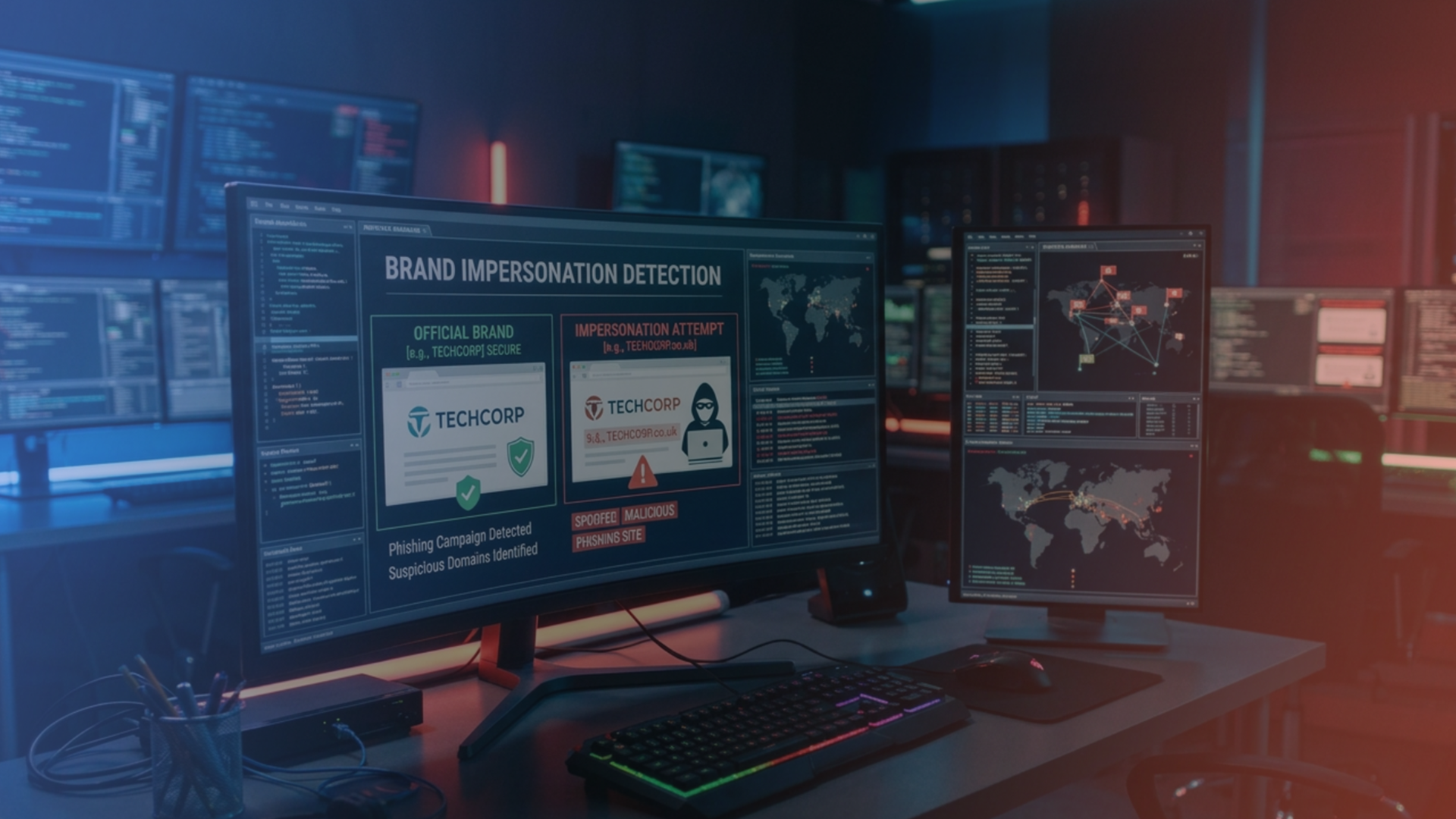
The impersonation that matters most is the kind organizations never see coming. Here’s what to do about it.
Brand impersonation that actually costs organizations money rarely looks like a fake logo or a knockoff social account. It resembles your own infrastructure but was built by someone else.
When a domain is registered to look just like yours, or mail servers, certificates, and login pages are created that mimic the real thing, they sit quietly, waiting to phish your customers, your partners, or your own employees. By the time this spoofed infrastructure is used in an attack, it has usually already existed for days or even weeks.
The damage rarely stops at a single phishing email. Spoofed infrastructure erodes the trust a brand depends on. A customer burned by a fake portal can’t distinguish between “the real company” and “the domain pretending to be it.” This can be especially damaging in high-trust sectors such as finance, healthcare, government, or critical infrastructure. A convincing impersonation can lead to fraud, data loss, or a breach that started with a vendor nobody thought to check.
“Silent Push turns our visibility into attacker infrastructure into direct protection for our customers’ brands. We catch the impostors targeting them before those domains are ever weaponized.”
Ken Bagnall, CEO and Co-Founder, Silent Push
Impersonation Lives in a Blind Spot
Traditional security tools watch your perimeter. They don’t watch the internet for infrastructure pretending to be you. Since look-alike infrastructure lives on someone else’s registrar and hosting, it never touches your logs until it’s too late. Too often, security teams learn through a customer complaint, and that’s the worst possible detection method because it means the attack has already launched.
This is where our Indicators of Future Attack® (IOFA) change the equation. Instead of waiting for a phishing report to confirm an attack, IOFA surface the infrastructure being staged before it’s weaponized. Brand and infrastructure impersonation is one of the clearest cases where this distinction matters. The domain, certificate, and login page are all set up before the first phishing email goes out. The question is whether anyone is watching for them at the preparation stage.
How Silent Push Closes the Gap
Our preemptive cyber defense technology already maps the internet’s infrastructure, and our next-generation brand impersonation detection engine turns that visibility toward your organization. Register the domains, IP ranges, ASNs, and TLDs your organization owns, and the engine continuously watches for infrastructure impersonating them. Detection runs on a schedule and notifies your security team the moment new candidates appear, so monitoring is ongoing instead of a periodic check nobody has time to run.
Finding the look-alike is only step one. Every candidate is scored by risk and enriched with the context that separates a real threat from noise: registrar, hosting, ASN, and page-title content. From there, candidates are clustered by shared infrastructure, which reveals when the same threat actor is behind multiple domains at once. Analysts can pivot on that signature to surface more of the same actor’s footprint before it’s used against them.
What This Means for CISOs
Brand impersonation is a board-level risk wearing a technical disguise. One convincing look-alike domain can trigger customer fraud, regulatory exposure, and a trust hit that outlasts the incident itself. We developed our brand impersonation engine to give Chief Information Security Officers (CISOs) continuous, scheduled visibility into that risk instead of a reactive scramble after a customer or partner reports it. Risk scoring enables your team to prioritize what threatens the brand instead of chasing every registered look-alike domain that pops up.
What This Means for CTI Analysts
Clustering is where this feature enables threat hunters. Instead of triaging look-alike domains one at a time, Cyber Threat Intelligence (CTI) Analysts can pivot on shared infrastructure signatures to map a threat actor’s full footprint in one action. Registrar, hosting, and page-title enrichment give analysts the context to distinguish an opportunistic squatter from a coordinated impersonation campaign and prioritize accordingly.
Once a candidate is identified, the evidence doesn’t stay stuck in the platform. Domains of interest can be exported directly for Incident Response (IR) Leads or a takedown partner to act on, so the handoff from detection to takedown doesn’t require rebuilding a case from square one.
Finding Infrastructure in the Preparation Phase
Defenders can’t protect against impersonation that they can’t see. Organizations that handle this effectively don’t wait for a phishing report. By watching for infrastructure being staged against them, they can act while it’s still just a domain being set up and not yet an attack.
Ready to See What’s Impersonating Your Brand Right Now?
Start a conversation with one of our platform experts to learn how preemptive cyber defense can give your team more lead time on adversary infrastructure, before an attack is launched against your organization.
We also offer a free Community Edition so defenders can see how our platform integrates with their existing security stack.
FAQs
How is this different from a typosquatting monitoring tool?
- Typosquatting tools typically flag domains that look similar to yours and stop there. Next-Gen Brand Impersonation goes further by scoring each candidate by risk, enriching it with registrar and hosting context, and clustering related domains by the threat actor behind them, so your team knows which ones warrant action.
What counts as infrastructure I can register for monitoring?
- Domains, IP ranges (CIDR blocks), ASNs, and TLDs that your organization owns. Once registered, the detection engine continuously scans for infrastructure impersonating any of them.
Can we use this to build a case for a takedown provider?
- Yes. Once you confirm a candidate as a genuine threat, you can export the supporting evidence directly, whether your team or an external takedown partner is handling the removal.