

Silent Push has been honored with the inclusion in the Fast Company feature on the top 50 of “The most innovative cybersecurity companies of 2026.”
Such recognition of innovation alongside some of the most groundbreaking organizations is a welcome accolade for the Silent Push team’s commitment to preemptive cyber defense and encourages it to stay the course in defining this new security technology.
Silent Push Co-Founder and CEO Ken Bagnall acknowledged both the Silent Push team and its users:
“Huge congratulations to our incredible team, whose dedication to preemptive defense makes this possible. We’d also like to thank our customers for their continued trust and partnership.”
The Fast Company article points out that protecting data was difficult enough when (malicious) hackers were human. Now, generative AI further tilts the playing field, emboldening attackers to continually evolve to evade defenders.
The article continues, stating that some “Companies’ CEOs insist that good cybersecurity is no longer a cost center but a revenue accelerator—helping to make enterprises’ AI systems stronger, instilling trust, and speeding up usage.” It also takes the position that “Weak security weakens the already fragile sense of trust many of us have around AI…Just one gnarly hack or leak by an AI agent could be enough to squash trillion-dollar dreams of adoption.”
Legacy security solutions cannot keep ahead of threat actors. Silent Push technology builds on the success of traditional defense methods, ultimately evolving the security stacks of modern organizations with solutions that neutralize threats before they compromise networks.
Silent Push is continually improving modern threat defense, helping organizations stay ahead of threats with our Indicators of Future Attack® and innovative solutions such as Traffic Origin.
Trust is a liability in an era where it only costs a few dollars to rent domestic identities and clean residential IPs. Accurate compliance requires more than simply checking a passport; it requires verifying how connections behave on both physical and technical levels. Without the ability to identify upstream points of origin, defensive readiness remains reactive and incomplete, leaving organizations at risk of missing critical windows to block professional fraudsters and “invisible insiders” before they slip past existing security measures.
Silent Push Traffic Origin unmasks deceptive network paths that operatives use to hide their true location. We help you spot the residential proxies and suspicious connection patterns that state-sponsored groups use to bypass traditional geofencing and let you flag high-risk infrastructure and individuals before an attack occurs.
We use a proprietary global observation network to analyze traffic signals, enabling the platform to identify the countries associated with an IP address. This reveals the true physical origin of web traffic, not just where a proxy server sits.
By providing the visibility needed to ensure your KYC (Know Your Customer), AML (Anti-Money Laundering), and fraud workflows are grounded in technical truth rather than digital deception, Traffic Origin can help protect your organization.
Traffic Origin complements our proprietary residential proxy data, which identifies tens of millions of residential proxy IPs and their service providers. Together, these two solutions can help customers differentiate between innocuous residential IPs and those rented for global criminal use.
Working to shape a safer today and tomorrow, we recently updated the Silent Push platform with new search capabilities and a what’s new section to see the latest enhancements at a glance.
In the coming weeks, we will be sharing new developments on our unique AI-powered technology and how it provides deterministic certainty in place of typical cybersecurity guesswork.
Interested in learning more about Silent Push preemptive cyber defense technology?
Start a conversation with one of our platform experts to see how our solutions can protect you and your organization by neutralizing threats before an attack is fully launched.
We also offer a free subscription to our Community Edition, which gives cyber defenders and researchers introductory access to the Silent Push platform and datasets.
Silent Push joins the ranks of Google, Nvidia, Adidas, Walmart, and more
Reston, VA (March 24, 2026) — Silent Push, a leading preemptive cybersecurity vendor, is proud to have been named to Fast Company’s prestigious list of the World’s Most Innovative Companies of 2026, ranking No. 14 in the Security category. This year’s list shines a spotlight on businesses that are shaping industry and culture through their innovations. Alongside the World’s 50 Most Innovative Companies, Fast Company recognizes 720 honorees across 59 sectors and regions.
“Being recognized by Fast Company as one of the World’s Most Innovative Companies is a powerful validation of our mission to shift organizations to preemptive cyber defense.” said Ken Bagnall, CEO and Co-Founder of Silent Push.

“For too long, the industry has operated reactively, chasing indicators of compromise after damage is done. We built Silent Push to flip that model, giving defenders the ability to see attacker infrastructure before it’s weaponized and stop threats before they happen.”
Over the past 18 months, Silent Push has redefined threat intelligence by pioneering Indicators of Future Attack® (IOFA®), a new approach that shifts security teams from reactive response to proactive defense. Unlike traditional indicators of compromise that focus on known, already-used threats, IOFA® enables organizations to identify and track adversary infrastructure at its earliest stages. Through continuous innovation across its platform, including capabilities like Total View, IP Context, and advanced infrastructure analysis, Silent Push provides deep visibility into how attackers build, evolve, and operate their campaigns across the internet.
A key milestone in this evolution is the launch of Traffic Origin, a breakthrough capability designed to expose the true upstream source of malicious activity, even when attackers attempt to hide behind residential proxies, virtual private networks, or laptop farm operations. By revealing the real geographic and infrastructural origins of seemingly legitimate traffic, Traffic Origin allows organizations to detect high-risk activity earlier and prevent sophisticated fraud, insider threats, and nation-state attacks before they escalate.
Together, these innovations are enabling a new category of preemptive cyber defense. Silent Push customers, including Fortune 500 enterprises and government agencies, can now map and monitor adversary infrastructure in real time, identify patterns of malicious behavior before execution, and disrupt attacks at their inception. This shift from post-incident analysis to proactive threat prevention represents a fundamental change in how modern security operations are conducted.
The World’s Most Innovative Companies is Fast Company’s hallmark franchise and one of its most anticipated editorial efforts of the year. To determine honorees, Fast Company’s editors and writers review companies driving progress around the world and across industries, evaluating thousands of submissions through a competitive application process. The result is a globe-spanning guide to innovation today, from early-stage startups to some of the most valuable companies in the world.
“Our list of the Most Innovative Companies is about spotlighting organizations that don’t just adapt to change—they drive it.”
Brendan Vaughan, editor-in-chief of Fast Company.
“The companies we honor this year are redefining what leadership looks like in 2026, pairing bold ideas with measurable impact and turning breakthrough innovation into real-world value. They are setting the pace for their industries and offering a blueprint for what sustained innovation can achieve.”
The full list of Fast Company’s Most Innovative Companies honorees can now be found at fastcompany.com. It will also be available on newsstands beginning March 31, 2026.
Fast Company will host the Most Innovative Companies Summit and Gala for honorees on May 19 in New York City. The summit features a day of inspiring content, followed by a creative black-tie gala including networking, a seated dinner, and an honoree presentation.
About Silent Push
Silent Push is a preemptive cyber defense company. It is the first and only solution to provide a complete view of emerging threat infrastructure in real time, exposing malicious intent through its Indicators Of Future Attack™ (IOFA™) data, enabling security teams to proactively block hidden threats and avoid loss. The Silent Push standalone platform is also available via API, integrating with various security tools, including SIEM & XDR, SOAR, TIP, and OSINT, providing automated enrichment and actionable intelligence. Customers include some of the world’s largest enterprises within the Fortune 500 as well as government agencies. A free Community Edition is available. For more information, visit www.silentpush.com or follow on LinkedIn and X.
About Fast Company
Fast Company is the only media brand fully dedicated to the vital intersection of business, innovation, and design, engaging the most influential leaders, companies, and thinkers on the future of business. Headquartered in New York City, Fast Company is published by Mansueto Ventures LLC, along with fellow business publication Inc. For more information, please visit fastcompany.com.
Silent Push preemptive cyber defense offerings continue to grow and evolve with new visual accessibility and search features that transform how users interact with the platform, while drastically lowering the barrier to entry for complex threat-detection searches.
In the latest update, highlights include an enhanced landing page, a new Insight Search function, the addition of the Domain Search datasource to SPQL (Silent Push Query Language), and expanded intelligence via WHOIS tabs.
Additionally, five key partnership integrations are being formalized with Cyware, Google SecOps, Legion Security, Maltego, and ServiceNow to secure our place in the security stack.
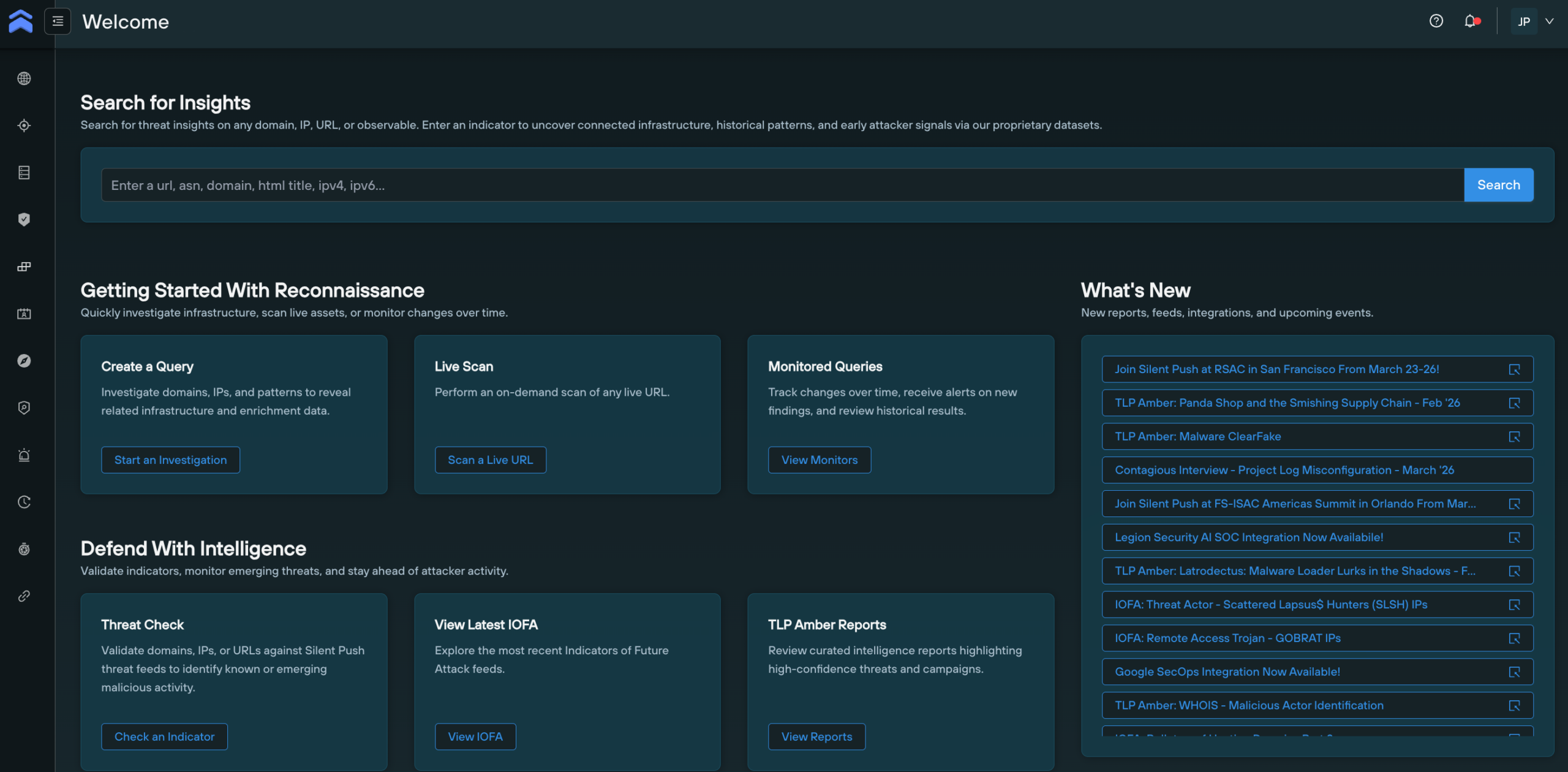
Enterprise users now have an updated home screen with immediate access to:
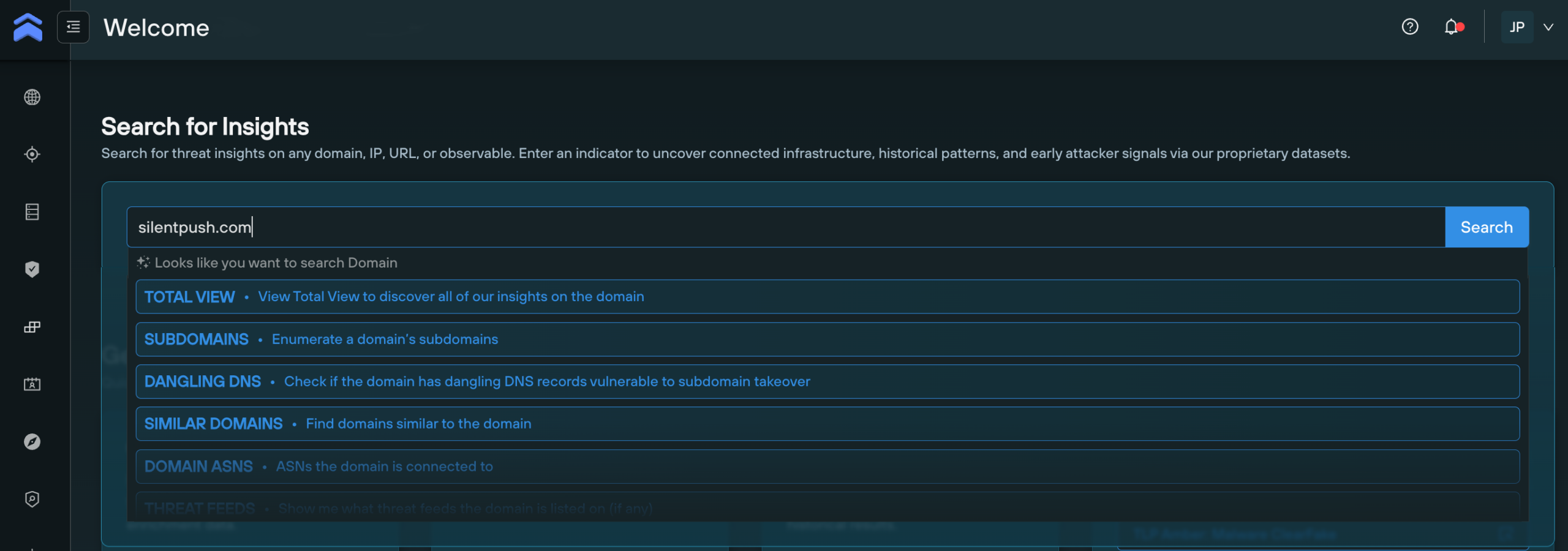
In addition to the enhancements made to the platform landing page, new features include:
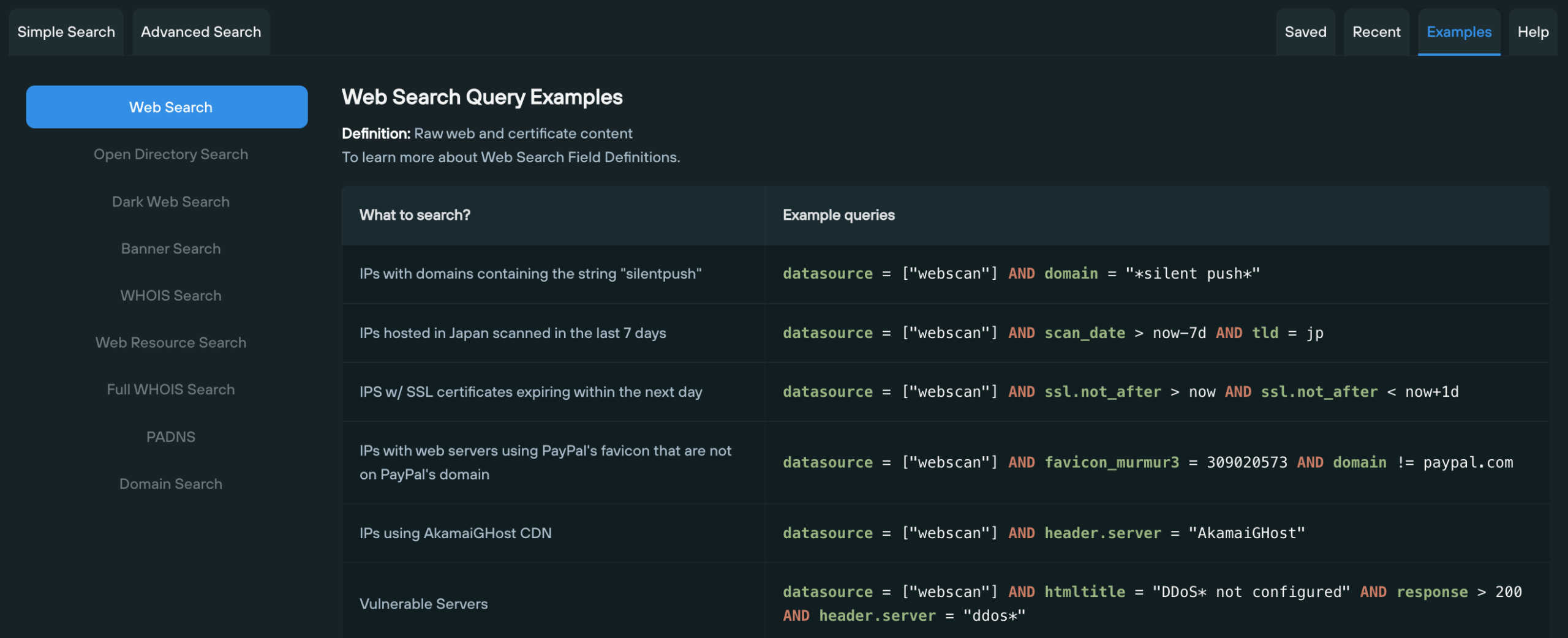
Interested in learning more about preemptive cyber defense? Get a conversation started with one of our experts to see how our solutions can work for you and your organization—neutralizing malicious cyber threats before they can execute in-network attacks.
We also offer a free subscription to our Community Edition, where cyber defenders can take our platform for a test drive, run web searches, and see how our queries work.
Sign up today and see for yourself.



The global average cost of a data breach has finally decreased for the first time in five years, falling to $4.44 million (IBM, 2025). However, detection remains a critical failure. According to the 2025 Verizon DBIR, external actors or ransomware groups still disclosed the incident in 82% of cases. This confirms that most organizations only discover a breach when the attacker chooses to reveal it, usually through an extortion demand or a public leak site.
Often we see Security Operations Centers (SOC) and Incident Response (IR) teams trapped in a reactive loop. Traditional tools are designed to alert you once a threat is already inside your wire. By then, the damage is underway. Your analysts are left to manually reconstruct infrastructure relationships using a fragmented mess of spreadsheets and disconnected point tools. This manual scramble is the primary driver of alert fatigue and extended response times.
Every second counts during triage, making tool-hopping a liability. Your team needs immediate clarity into unknown threat infrastructure to end the era of disjointed investigations.
Instead of guessing, analysts can now access a single, deterministic source of technical context that consolidates enrichment, risk scoring, and correlation into one view. This provides over 100 contextual attributes for any domain or IP, allowing your team to stop chasing tabs and start neutralizing threats.
Legacy tools often require analysts to perform the heavy lifting of correlation in the heat of a crisis. This is why we had to take a different approach. We spent years building the Context Graph so it could now become the foundational engine that pre-correlates changes in the global internet dataset.
While an attacker is still building their infrastructure, the Context Graph is already mapping those technical relationships. For example, when an analyst queries an unknown indicator, the platform uses Context Similarity to identify related malicious assets and cluster threats instantly. This allows an IR team to link a single indicator to an entire adversary campaign in seconds, rather than days of manual forensic work.
Operationalizing forensic data before it is weaponized against you changes the math of your security stack. By moving the defense line upstream, you achieve several key metrics:
| Objective | Operational Impact |
| Accelerated Triage | Drastically reduce Mean Time to Triage (MTTT) with unified enrichment that captures adversary infrastructure in its staging phase. |
| Workflow Consolidation | Eliminate tool sprawl by establishing a single source of truth for all analysts. |
| Resource Optimization | Free high-tier analysts from manual data gathering so they can focus on strategic mitigation. |
Moving your defense upstream allows your team to identify and block attacker infrastructure weeks before a campaign is even launched. This shift from detect and respond to anticipate and prevent is how modern SOC teams to actually reclaim the advantage.
If you are looking to move your team past the triage bottleneck and into preemptive threat detection, book a demo with our platform experts today.
What data sources power the Context Graph? The Context Graph is powered by pre-correlating a massive global dataset, comprising of Passive-Aggressive DNS (PADNS), WHOIS, certificates, traffic sensors, and content hashes. It continuously analyzes benign, gray, and malicious infrastructure to detect adversary “management patterns” rather than just active exploits.
Does Insight integrate with our SIEM/SOAR/XDR platform natively? Yes. Insight is designed for native integration with SIEM, SOAR, and XDR platforms via APIs and prebuilt connectors, allowing enrichment, scoring, and context data to flow directly into existing workflows without requiring analysts to leave their current tools.
How does this help my team work across silos? The Context Graph acts as a single backbone for the entire company. Whether it is the SOC triaging alerts or fraud teams stopping fake logins, everyone uses the same engine to make fact-based decisions.
Why is deterministic data better than probability scores? Probability scores tell you something might be bad, which creates noise and alert fatigue. Deterministic data provides a binary ‘True’ or ‘False’ answer, allowing you to automate defense without the guesswork.
DNS investigations often stop at resolving a domain to an IP address, leaving valuable context undiscovered.
In this cyber defense workshop you’ll learn how to recognize meaningful DNS overlaps versus coincidence, so you can apply this practical workflow and confidently identify broader infrastructure patterns to enhance your preemptive strategy.

Modern AI security tools are heavily focused on reducing operational bottlenecks. It might help analysts clear an alert queue faster or prioritize which fires to put out first. While these efforts are valuable for efficiency, they don’t fundamentally change the game; they just help teams react more effectively to attacks that have already breached the perimeter.
If your AI security tools only focus on making the SOC run faster, you are still just playing a faster version of the attacker’s game.
True strategic advantage requires a shift to Preemptive Cyber Defense. By identifying malicious activity while it is still being staged, organizations can stop bottlenecks before they ever occur.
Traditional security relies on Indicators of Compromise (IOCs). These are essentially digital post-game highlights of a match you already lost. If your AI strategy is solely focused on filtering these old signals faster, you are still just documenting a failure.
In the security industry, the term “Left of Boom” is often straight-up marketing fluff. But attackers do not appear out of thin air; they build, stage, and test their infrastructure weeks or months before a campaign begins.
Being able to confidently identify these future attacks is the only way to get truly Left of Boom. Instead of waiting for an attack to hit your sensors, we constantly re-resolve and pre-correlate the global DNS record set. This provides a window into infrastructure while it is still being constructed by monitoring:
Legacy tools are often stuck looking at static snapshots of known-bad infrastructure. The Context Graph maps the internet’s technical relationships and daily changes across benign, unknown, and known-bad assets to create a defined source of truth. It provides certainty because it acknowledges the reality of the cat-and-mouse game: the infrastructure that hits you tomorrow is almost certainly masquerading as “benign” today.
The Context Graph connects billions of disparate signals into a coherent map of internet infrastructure, moving security from probability-based guessing to deterministic certainty.
This engine is what makes AI-enhanced operations genuinely proactive. By becoming embedded upstream in security reasoning, both human and machine gets the reliable, preemptive context needed to act with confidence. Instead of giving an AI agent noisy probability scores to sort through, the Context Graph provides:
By neutralizing threats before they reach your perimeter, you fundamentally change attacker economics. Every time you block staged infrastructure, the attacker must scrap their work and spend more resources to start over. This makes their iteration loop slower than your defensive loop, shifting the organization from emergency response to strategic control.
If you are looking to move your team past the triage bottleneck and into preemptive threat suppression, book a demo with our platform experts today.
Can I use this with my current security tools? Yes. Silent Push integrates with major platforms like Splunk, Tines, and Palo Alto XSOAR to feed high-fidelity data directly into your existing stack.
What is the difference between an IOC and a preemptive signal? An Indicator of Compromise (IOC) is a post-breach record of where an attack has been. A preemptive signal, such as an Indicator of Future Attack (IOFA)™, identifies malicious infrastructure while it is still being built and staged.
How does this help my team work across silos? The Context Graph acts as a single backbone for the entire company. Whether it is the SOC triaging alerts or fraud teams stopping fake logins, everyone uses the same Architecture of Certainty to make fact-based decisions.
Why is deterministic data better than probability scores? Probability scores tell you something might be bad, which creates noise and alert fatigue. Deterministic data provides a binary ‘True’ or ‘False’ answer, allowing you to automate defense without the guesswork.